However practically important, it’s never the sexiest part of a project to be the person who persuades someone else to put their hand in their pocket. Perhaps that is why Ellen Willmott has not – until now – been officially celebrated at RHS Wisley.

Then again, there could be an even more prosaic reason: until very recently no one could be sure that Ellen actually did persuade Sir Thomas Hanbury to purchase George Wilson’s Surrey garden and donate it to the RHS.
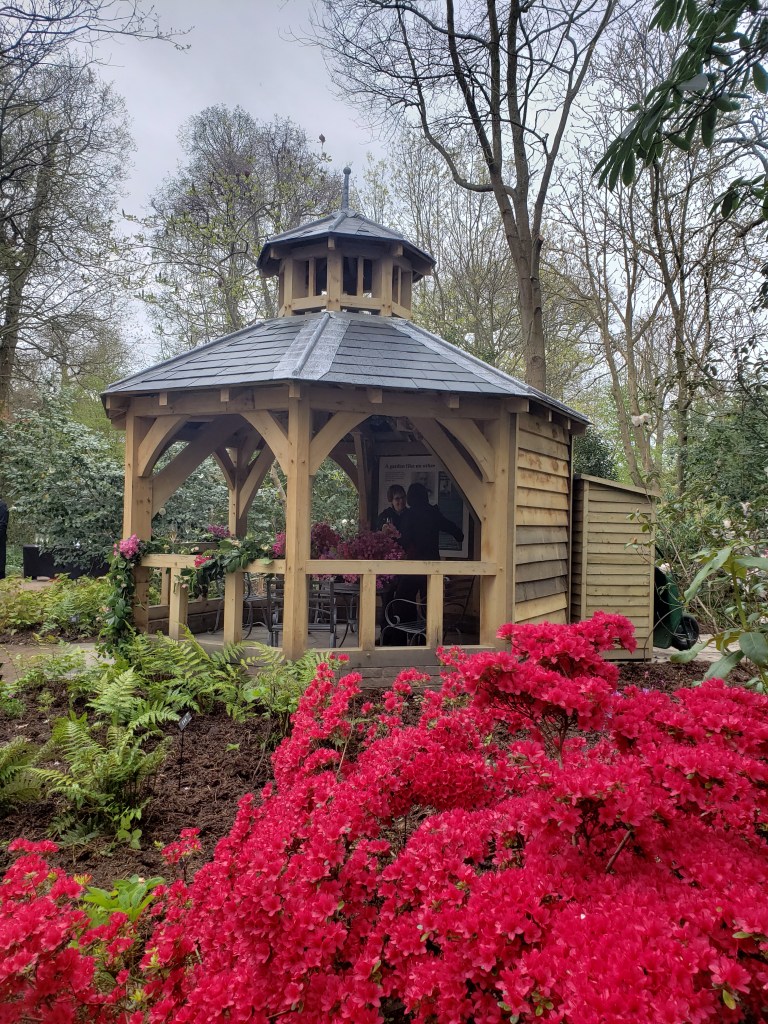
At last, however, a new summer house has been opened in the Oakwood Garden at Wisley’s historic core, celebrating Ellen alongside the other three (frankly, there should be four, as we’ll see in a moment) major players in the site’s acquisition. Oh, and there is a new benefactor to celebrate too…
So, back in 1903, the RHS was once again in disaccord. It was nothing like the mess it had known in the 1870s where mismanagement, political in-fighting, personal jealousies and downright corruption had almost done for the organisation. That was serious stuff – they lost their home and their splendid garden just outside the Royal Albert Hall (the area where all those very smart mansions are now…)

Thanks largely to a group spearheaded by the Secretary, Reverend William Wilks, the Society had come back with a bang in the 1890s, and was flourishing once again, to the point where they had a fast-growing membership (no pun intended). Wilks had even engineered money in the bank – £15,000! They just couldn’t agree on how to spend it.

Most of the big mouths wanted a swanky new building, and construction on Horticultural Halls at Vincent Square was well underway. Alas, the money in the bank wasn’t that large and by January 8th, funds were beginning to get a bit stretched.

Wilks was getting nervous. The plans were lavish and the interior was going to be pricey. So pricey, in fact, that there were even mutterings the society might have to abandon the project entirely. Gertrude Jekyll was of the cut-it-loose persuasion:
Miss Jekyll now proposes that we should abandon the scheme altogether – forgetting that this is now impossible, with honour...
…wrote Wilks, realising that Baron Schroder, the poor old chap who had stumped up the cash to buy the lease until the society could pay him back, would be left with a 999-year lease on a ‘useless’ patch of land if the RHS walked away.

They had to build. The best solution was to keep the lovely internal decoration (which largely still exists) and ditch the more elaborate plans for the building’s exterior.
Poor Wilks had never wanted a building anyway. He was part of a different faction that had lobbied for a Society garden where horticultural trials could take place – after all. what was a gardening society without a garden? The one they’d had as a temporary measure at Chiswick was just that – temporary – and was now being relinquished.
Alas, he, Ellen – and a slightly smaller group than the one that wanted the building – had been overruled. “We were beaten, ” he says, candidly admitting “I deeply regret the decision”.
Ellen was a sympathetic ear to her good friend Rev Wilks’s situation as being the individual who had to see-through a project he didn’t agree with – with diminishing funds and permanently grumpy members who enjoyed airing their grievances at him. She would have understood when he wrote
Dear Lady I could wish it were possible for me to go to sleep and not wake up again til this wretched Hall were finished. I cannot tell you the worry and unhappiness it is to me. If they had only let us have a Garden!!
Wilks is very candid indeed about his feelings, regarding the building, individuals concerned and his desire for a garden, and over several letters we feel his pain. He is trying to do his best but everyone has a different idea about how he (not they, of course,) should deal with the mess.

We do not have Ellen’s replies to Wilks (though it is entirely possible they still exist; I have my suspicions as to where they are; fingers crossed…) so we can only put together the story via one half of the conversation that takes place over the next six months.

The first thing the pair try is a petition that Wilks writes the wording for but, as Secretary, cannot send, so he wants Ellen to do it. The idea is to create a new fund for the acquisition of a garden. As yet, the garden they would acquire is not known – all they have are the dimensions they want: “a suitable site of not less than 20 or more than 50 acres”.
Ellen has mentioned a name though. She has clearly made a suggestion for a benefactor:
Your news about Sir T.H. makes my mouth water. How many many times I have longed for some good beneficent fairy who both could and would (I would but I can’t) give us or substantially help us to a real Garden.
Sir T.H. was Sir Thomas Hanbury. Ellen had known the Hanburys for years, perhaps since childhood. She had been visiting him at his home La Mortola on the Italian Riviera, for yonks, taking photographs and clearly coveting the place (she would eventually buy Villa Boccanegra, the site next door, again with Sir Thomas’s help).

Wilks didn’t know Sir Thomas – indeed, no one else did either. Ellen had to introduce him to the society and the other people involved but he was clearly amenable to the idea.

Someone else wasn’t. Sir William Thistleton Dyer, of the Royal Botanic Gardens, Kew, was vehemently opposed to the idea of the RHS getting a garden. Whether this was for reasons of finance, location or that old chestnut, the green-eyed monster, we will never completely know.

Wilks is adamant, the people at Kew “don’t want us & don’t mean us to have one [a garden] if they can in any way prevent it”. He is equally adamant that “we must insist in being allowed our Garden as well”.

Much to-ing and fro-ing goes on over the coming months, including the idea of purchasing Mr George Fergusson Wilson’s ‘experimental garden’, Oakwood.

The dear old gent had passed away the previous year, but many people were familiar with it, including Ellen who had been visiting him nearly every year for at least a decade. It would be perfect for trials.

We can just-about follow what’s going on (we really need to find the other half of that conversation…) but it doesn’t help that in the same letters as Wilks is talking about an RHS garden he is also discussing his own.
The poor Reverend was having some financial difficulties and faced losing his garden at Shirley Vicarage, Croydon; Ellen was rallying the troops to help him keep it at exactly the same time as she was helping him cook up the Wisley plan, perhaps another reason why letters elsewhere have not been recognised as being about Wisley.

Presumably the meeting at which Sir Thomas is introduced to the movers and shakers in the Society on Monday 17th August went well, as the gift went ahead.
At last the Reverend was able to write to his great friend Ellen Willmott, “How can I ever thank you enough for Sir T.H.’s promised Gift? Only I fancy by doing our best when we get the Garden to keep it up well as a Nature-Garden & not as a set or formal Garden.”

Oakwood was purchased, Ellen became one of the first ever garden Trustees and RHS Wisley has thrived (with one or two lumps and bumps along the way) ever since.
Last year I was delighted to take Wisley’s Curator, Matthew Pottage, around what’s left of Ellen’s garden at Warley Place (which, in an alternative universe is RHS Warley, but that’s another story…) for BBC Radio 4’s Gardeners Question Time. It was a delightful day and I had a ball, but there was to be another brilliant outcome.

One of the RHS Fellows, Patricia Smith, happened to be listening. Patricia loves both Ellen Willmott and RHS Wisley – she’s a regular visitor – and thought it would be lovely to have something at Wisley to commemorate Ellen’s contribution to the garden – alongside Sir Thomas and George Wilson, of course.

She contacted the Society and offered her help. Matt thought a tree might be nice (I’d have suggested a monkey puzzle, which I know Matt would have agreed with…) – but Patricia had bigger ideas. In true Sir Thomas Hanbury style, she pooh-poohed a mere tree. She wanted something bigger. Perhaps a summer house? Unsurprisingly the idea was very enthusiastically embraced.

I was delighted to be invited to the opening:

…and it was entirely fitting that Patricia should cut the ‘ribbon’ (actually a swag of spring flowers) last Wednesday at the official opening.

Image: (c) Sandra Lawrence
What a summer house! Beautifully crafted in solid oak wood (for obvious reasons), semi-open, with a delightful lantern – who puts a lantern on summer houses these days? The RHS and Patricia Smith do – and I love it:

There are also little balustrades at the front. In fact it is not unlike something Ellen herself would have had at Warley. She was a great summerhouse fan – she had at least seven in her pleasure grounds alone, let alone the rest of the site – I’m gradually talking about them on this blog.

I am so pleased with the effect – it gives the Oakwood garden, which is especially beautiful at this time of year, a new focal point, a new place to pause a while, a new place to feel at home with Wisley’s earliest characters…

…and of course, its most recent carers, the garden team, doing such a great job of keeping the place as lovely as it ever was, especially the plants that survive from its very earliest years.

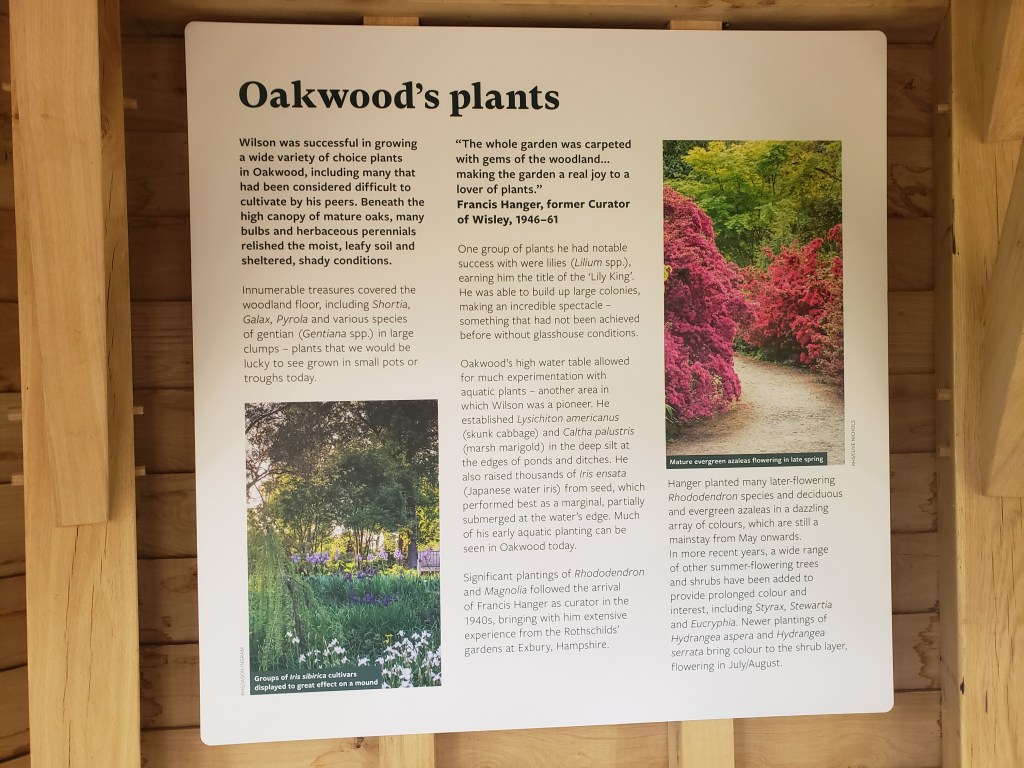
The panels inside give us the story:

…and tell us more about the plants:
Oh, and don’t feel too sorry for the Reverend William Wilks, who isn’t much mentioned in the panels. He has had his own set of very fine gates at Wisley, incorporating his famous Shirley Poppy, since 1925.

 Miss Willmott's Ghosts